
Why WordPress

Why Wordpress Is Best For Web Design In Malaysia
Look, I'm not going to tell you WordPress is perfect. It's not the shiniest tool, it doesn't have the slickest marketing, and honestly, the dashboard looks like it hasn't changed much since 2010.
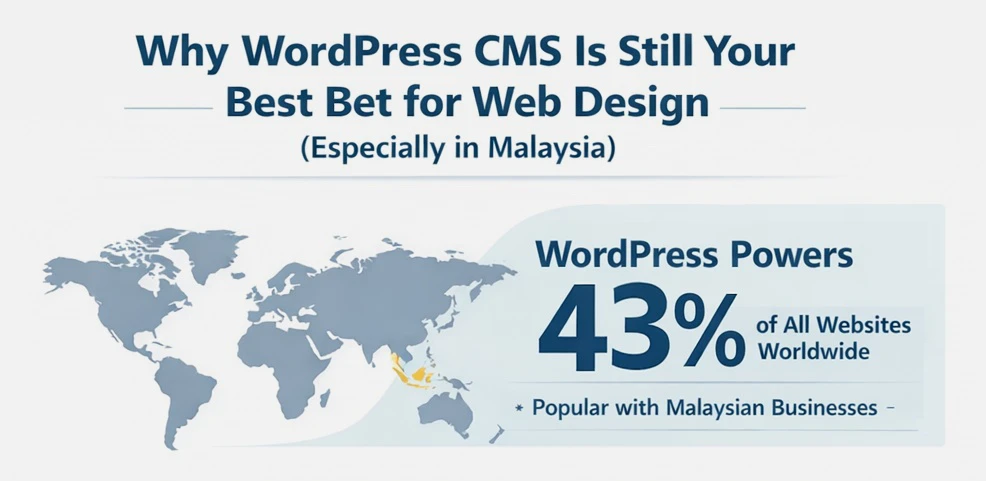
But here's the thing: WordPress powers 43% of all websites on the internet right now. That’s not an accident.
And if you're running a business in Malaysia—whether it's a corporate website, SME profile, or eCommerce store—that number matters more than you think.
Why Wordpress Still Dominates The CMS Market
Most articles will tell you WordPress is "flexible" and "customizable." Sure—but what does that actually mean when you're trying to fix your website at 11 PM and something breaks?
It means when you Google your problem, you'll find 47 different solutions because millions of people have already hit that same wall.
Try doing that with a newer platform. You'll find three forum posts and maybe one YouTube video with 200 views.
WordPress has been around since 2003. That’s not a bug—it’s a feature.
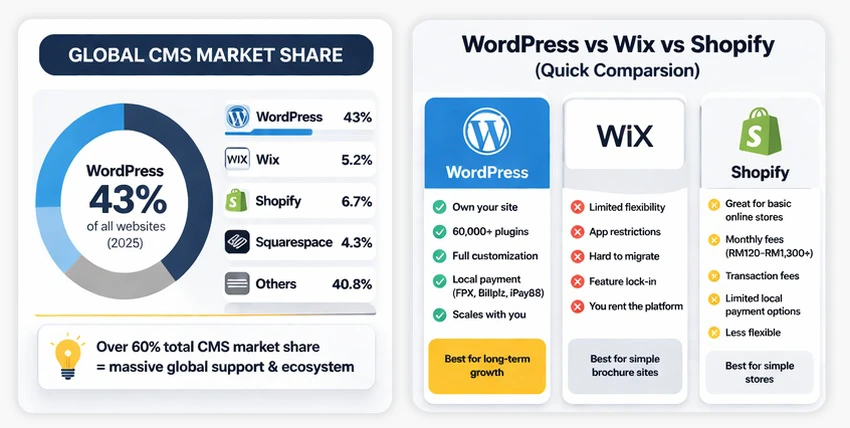
It holds over 60% of the CMS market share globally, which means the collective knowledge base is massive. Every weird issue, plugin conflict, hosting error—someone’s already solved it.
For Malaysian businesses, this is huge. It means you're not dependent on a single vendor or agency. You have options.
THE REAL ADVANTAGE OF WORDPRESS FOR MALAYSIAN BUSINESSES
Massive Community & Problem-Solving
Because WordPress is so widely used, you’re never stuck alone.
Unlike newer platforms, where support is limited, WordPress gives you access to:
- Global forums
- Tutorials
- Developers at every price range
This is especially useful in Malaysia, where businesses often want flexibility without being locked into one agency.
WORDPRESS VS WIX VS SQUARESPACE: WHAT YOU NEED TO KNOW
Wix and Squarespace are great. You can build a decent-looking website in an afternoon. For simple use cases, they work. But here’s what happens two years down the line.
The Limitation of Closed Platforms
You want to add something specific:
- A custom booking system for your clinic
- Integration with your company’s internal system
- A membership portal or training platform
- Or even something simple like connecting to a local payment gateway Now you’re stuck.
With Wix or Squarespace, you can only do what their platform allows. You’re renting space in their system. If they don’t support what you need—you either compromise or rebuild from scratch. WordPress?
There are over 60,000 plugins available. If it exists, someone has probably built it.
And if they haven’t, you can hire a developer—because WordPress is open-source.
You actually own your website.
THE MULTILINGUAL ADVANTAGE MOST PEOPLE COMPLETELY IGNORE
Here’s something especially relevant in Malaysia that almost nobody talks about when choosing a website platform. We’re not a single-language market.
Your customers search in:
- English
- Bahasa Malaysia
- Chinese
And sometimes a mix of all three in the same sentence.
If your website only works properly in one language, you’re already cutting off a huge portion of your potential traffic from Google.
WordPress Actually Lets You Do This Properly
With WordPress, you can install translation plugins like TranslatePress, WPML or Polylang. Now, a lot of platforms will say they support “multilingual websites.” Technically true.
But here’s the difference.
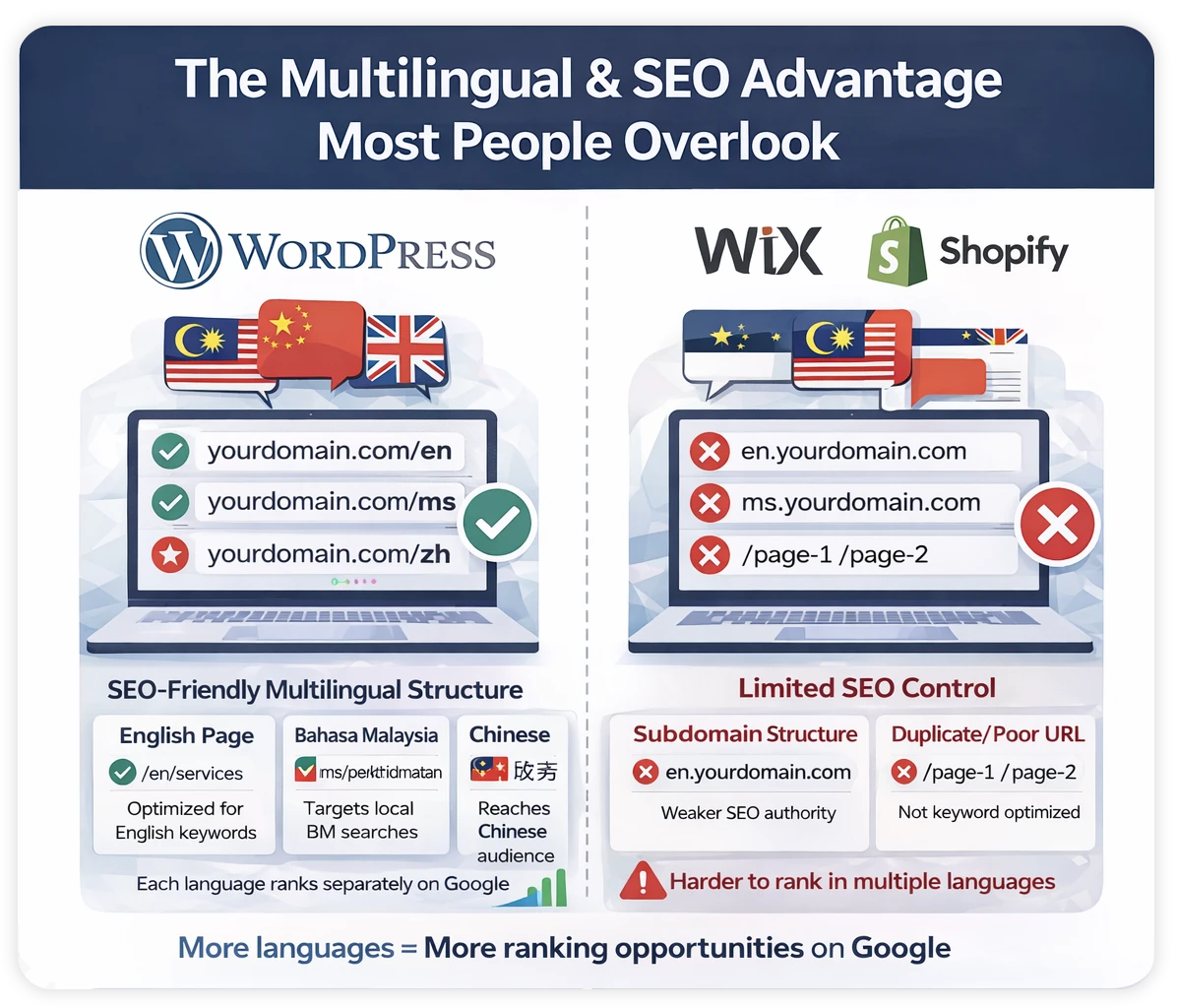
With WordPress, you’re not just translating text—you’re building separate, fully optimized pages for each language.
That means you can have URLs like:
- yourdomain.com/en/services
- yourdomain.com/ms/perkhidmatan
- yourdomain.com/zh/服务
Each page can target different keywords, different audiences, and rank separately on Google. That’s not a small thing.
That’s basically multiplying your chances of getting traffic.
Why This Matters More Than You Think
Google doesn’t rank your website as a whole.
It ranks individual pages.
So if you only have one English page, you’re competing in one lane.
But if you have:
- English version
- Bahasa Malaysia version
- Chinese version
You’ve just opened three different doors into your website. In a country like Malaysia, that’s a massive advantage.
What Wix, Shopify and Others Don’t Really Tell You
Platforms like Wix, Shopify, and Squarespace do offer multilingual features.
But once you actually use them, you’ll realise the limitations.
- Less control over URL structure
- Not as SEO-friendly
- More restrictions on how pages are created
- Harder to customise properly
It works—but it’s not built for serious SEO. WordPress is.
The Real Bottom Line
If your website is just a brochure, maybe this doesn’t matter.
But if you actually want traffic from Google—especially in Malaysia—this becomes a big deal.
Because now it’s not just about having a website.
It’s about how many ways people can find you.
And WordPress simply gives you more ways to win.
WOOCOMMERCE VS SHOPIFY: WHICH IS BETTER IN MALAYSIA?
Shopify is strong. No question.
If you’re running a straightforward online store, it works well.
But here’s where things get interesting for Malaysian businesses.
WooCommerce (WordPress’s eCommerce plugin) powers a massive portion of online stores globally—and for good reason.
Cost Comparison for Malaysian Businesses
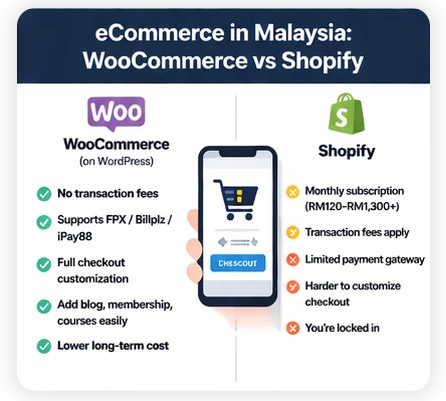
With Shopify:
- Monthly subscription (RM120–RM1,300+)
- Additional transaction fees
- Limited flexibility for local payment integrations
- You’re tied to their ecosystem
With WooCommerce on WordPress:
- You pay for hosting (roughly RM30 to RM2,000+ depending on scale)
- No forced transaction fees
- You can customize everything—from checkout to user experience
Payment Gateways in Malaysia (FPX, Billplz, iPay88)
Local payment support is critical.
WooCommerce supports:
- FPX
- Billplz
- iPay88
- Shopify may require workarounds or extra fees for these integrations.
And this matters in Malaysia, where:
- Customers expect FPX / local payment options
- Businesses want to avoid ongoing platform fees
- Flexibility is key for growth
The difference isn’t small.
It’s the difference between:
“I wish I could do this” and “Let me figure out how to do this”
HOW MUCH DOES A WORDPRESS WEBSITE COST IN MALAYSIA?
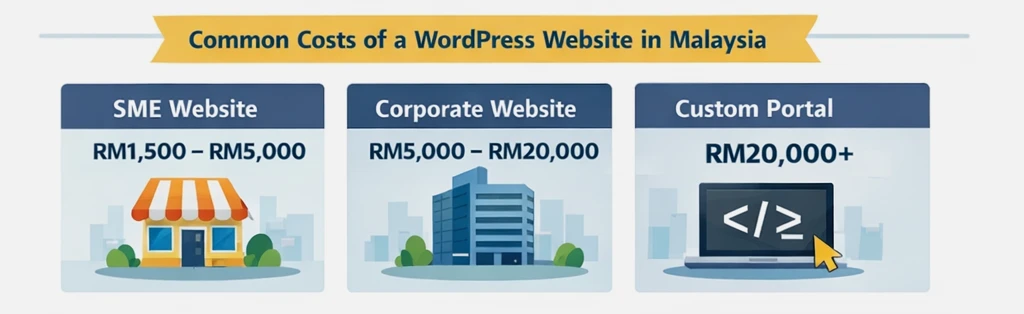
Here’s where people get WordPress wrong. They hear “WordPress is free” and assume everything else is too. It’s not.
SME Website Cost in Malaysia
- RM2,500 – RM5,000 (RM1,500 starting fee is solely from freelancer or single person agency)
- Suitable for basic company profiles
Corporate Website Cost
- RM5,000 – RM20,000
- Custom design, integrations, scalability
Custom Web System / Portal Cost
- RM20,000+
- Booking systems, membership portals, LMS
Now compare that to:
- Wix / Squarespace: RM60 – RM250/month
- Shopify: RM120 – RM1,300/month + transaction fees
Over 2–3 years, WordPress often costs less—and gives you far more control. But the real cost advantage shows up later. When you want changes.
With WordPress:
- You can hire any developer
- Competitive pricing
- No lock-in
With proprietary platforms:
- Limited experts
- Higher costs
- Less flexibility
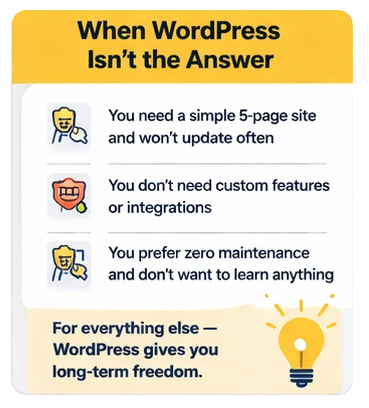
WHEN WORDPRESS IS NOT THE RIGHT CHOICE
Let’s be real.
If you just need:
- A simple 5-page website
- No future expansion
- No custom features
Then yes—Squarespace or Wix might be enough. WordPress does have a learning curve.
You’ll need to:
- Manage updates
- Set up backups
- Understand plugins and themes
It’s not “set and forget.” But if your business has any growth plans—this matters.
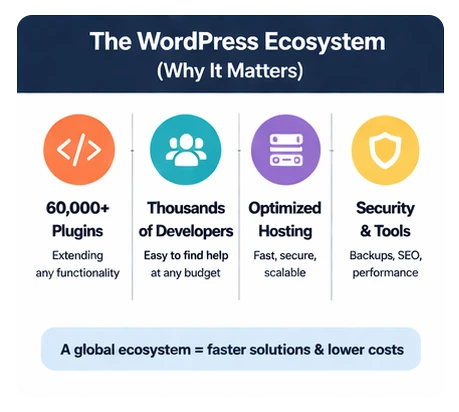
THE WORDPRESS ECOSYSTEM ADVANTAGE
WordPress isn’t just software.
It’s an entire ecosystem.
- Thousands of developers
- Tens of thousands of plugins
- Hosting providers optimized for it
- Security tools built around it
When you choose WordPress, you’re not choosing a tool. You’re plugging into a global system that’s constantly evolving. And unlike other platforms—it’s not controlled by one company. That means:
- Better pricing
- More options
- Continuous innovation
WHY OWNERSHIP MATTERS FOR MALAYSIAN BUSINESSES
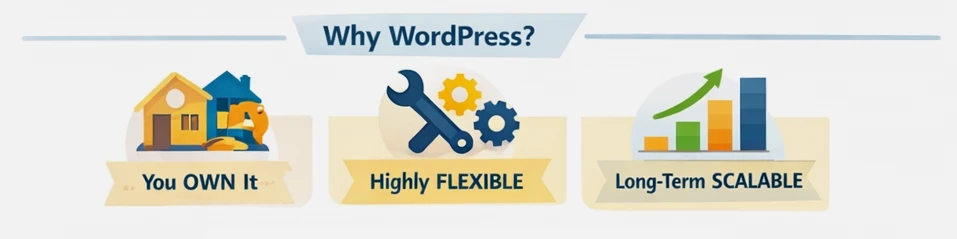
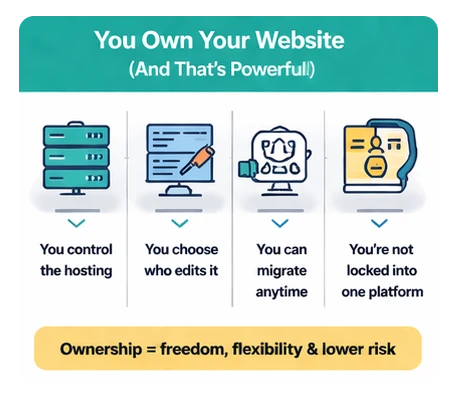
This is the part most people overlook.
With WordPress:
- You own your website
- You control your hosting
- You decide who works on it
With platforms like Wix or Shopify:
- You’re renting
- You’re tied to their system
- Migrating later can be painful
For many Malaysian SMEs, this is critical.
Because the common problem is: “My previous developer built everything and now I can’t change anything.” WordPress solves that.
CONCLUSION: IS WORDPRESS STILL WORTH IT IN MALAYSIA?
WordPress isn’t winning because of marketing.
It’s winning because it solves real problems.
Especially for businesses that:
- Want flexibility
- Want control
- Want long-term scalability
Is it the easiest platform? No.
Is it the prettiest? Debatable.
Is it beginner-friendly? Not the most.
But it is:
- The most flexible
- The most supported
- The most future-proof
And in the long run—that matters more.
You’re not just building a website.
You’re building a digital asset.
WordPress lets you actually own that asset.
Everything else is just renting.
FREQUENTLY ASKED QUESTIONS (FAQ)
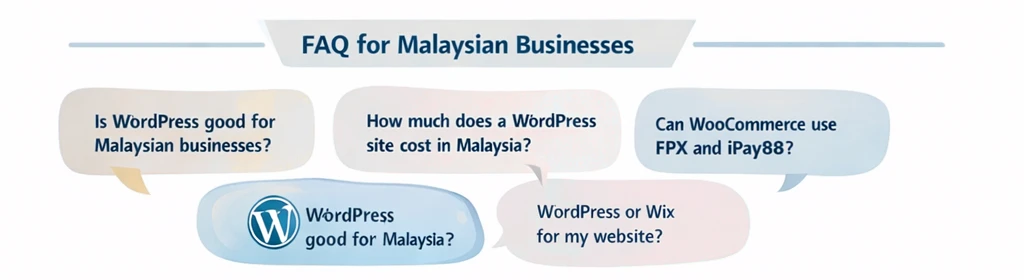
Is WordPress good for Malaysian businesses?
Yes, especially for SMEs and growing companies. It offers flexibility, ownership, and better long-term cost control compared to subscription platforms.
How much does a WordPress website cost in Malaysia?
Typically between RM2,500 to RM20,000+ (for freelancer typically the fee start at RM1,500) depending on complexity, features, and customization.
Is WooCommerce suitable for Malaysia payment gateways?
Yes. WooCommerce supports FPX, Billplz, iPay88, and other local payment integrations commonly used in Malaysia.
WordPress good for Malaysia
Yes, WordPress works very well in Malaysia. It supports multiple languages (English, BM, Chinese), works with local payment options, and is easy to grow as your business expands. You also have full control over your website, unlike some drag-and-drop platforms.
If you want long-term flexibility and ownership, WordPress is the better choice. Wix is suitable for very simple, short-term websites.